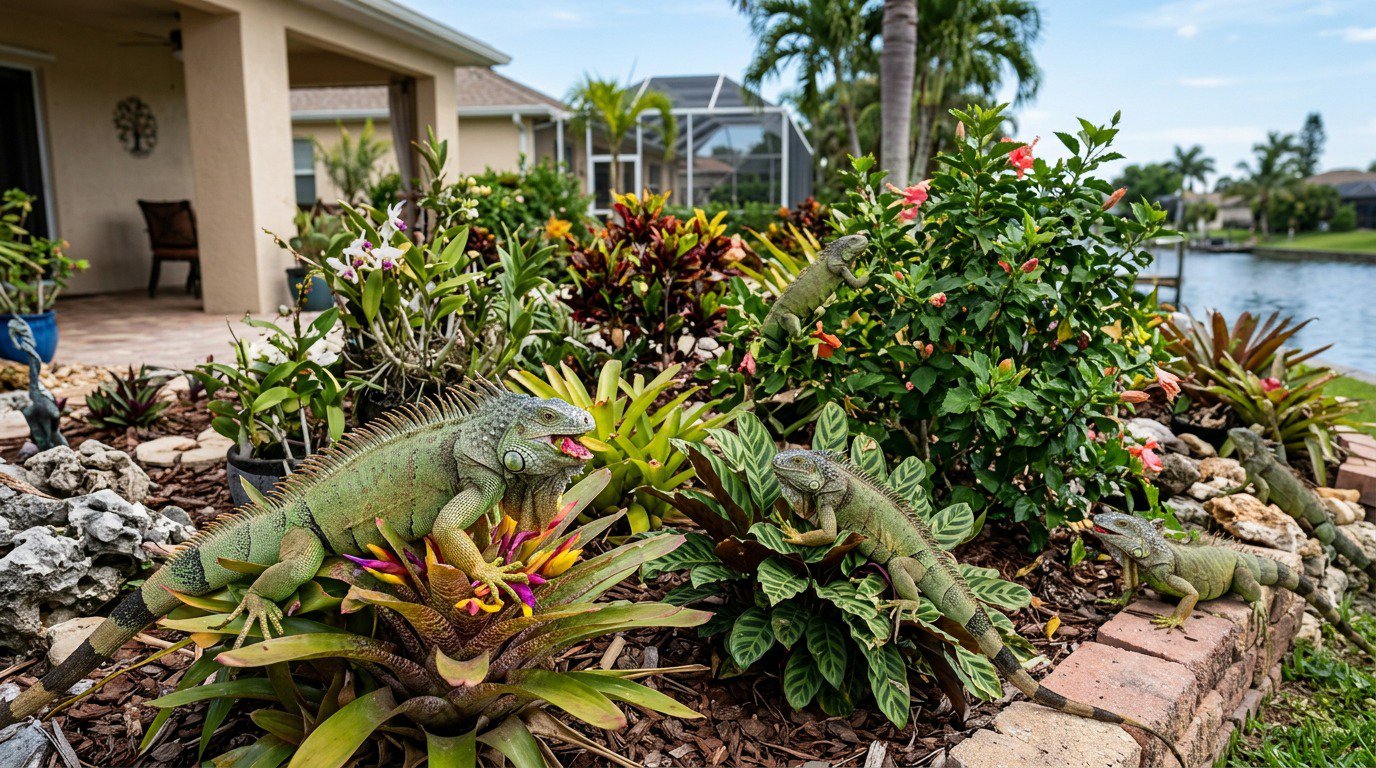
Why Iguanas Are Making a Comeback in South Florida After the 2026 Cold Snap
In late January 2026, the Florida Fish and Wildlife Conservation Commission issued Executive Order 26-03, clearing the way for the largest coordinated green iguana removal effort the state has run. Two days later, more than five thousand cold-stunned iguanas had been pulled from lawns, seawalls, and sidewalks across South Florida. Six months on, property owners from Miami-Dade to the Keys are reporting the same activity they saw before the freeze — iguanas back on fences, seawalls, and roof lines, as if the cold snap never happened.
It didn't reset anything. Understanding why the population is active again means looking past the headline number and at what actually happened to South Florida's iguanas underneath it.
What Happened During the February 2026 Cold Snap
On January 30, 2026, FWC issued Executive Order 26-03, temporarily waiving the permit normally required to possess a green iguana — a Prohibited nonnative species in Florida — so residents and collectors could gather cold-stunned animals and bring them to designated drop-off points without breaking the law.
The order arrived just ahead of an arctic push that dropped overnight lows into the mid-30s across South Florida on February 1 and 2. FWC opened five collection sites — Marathon, Sunrise, Tequesta, Fort Myers, and Lakeland — with windows running from 9 a.m. to noon on Sunday and 8 a.m. to 4 p.m. on Monday.
FWC Executive Director Roger Young called it "a pretty good deal for the local municipalities and the counties down in South Florida." Collected animals were either transferred to permitted facilities or humanely euthanized by trained staff. It was the first event of its kind, and by any measure it was a significant one-time reduction.
It was also, by the numbers, a partial one.
Why the Cold Didn't Eliminate South Florida's Iguanas
Green iguanas are ectotherms, meaning, their body temperature tracks the air around them rather than being internally regulated. When temperatures fall into the high 40s and below, their metabolism slows to the point of torpor: muscles stop responding, grip fails, and animals that were basking in trees fall to the ground. That's the mechanism behind every "raining iguanas" headline out of Florida, and it's what produced five thousand collectible animals in a single weekend. Think about how you feel when the temperature drops and how it affects your movement and your body. Its a remarkable wonder of nature, but causes its own issues.

It is not, on its own, a death sentence for this species. Most cold-stunned iguanas survive a brief overnight event and regain full movement — often aggressively — within hours of the sun returning. The real risk is prolonged exposure, which suppresses the immune system and leaves animals vulnerable to infection over days, not hours. A two-day cold snap, however dramatic, exposes and disables the surface-active population without touching the rest of it.
And the rest of it is substantial. A large share of South Florida's iguanas spend cold nights underground — in burrows dug into seawalls, canal banks, and building foundations — where soil insulation keeps them well above ambient air temperature. Those animals were never stunned, never fell, and were never part of the count. The 5,195 collected represent the iguanas that happened to be exposed in trees and shrubs when the cold arrived, not the population as a whole.
Why Iguana Activity Is Increasing Again
Green iguana breeding season in Florida runs from roughly December through April, with courtship and mating happening well within the state's cooler months. The survivors of the February cold snap — both the animals that rode out the freeze in burrows and the ones that recovered from cold stunning — were still inside that breeding window when temperatures normalized.
Females that bred during that period laid eggs in spring, typically April through June. FWC and university extension data put clutch sizes anywhere from 14 to 76 eggs per female, incubating for two to three months with no parental care. That timeline puts peak hatchling emergence squarely in the June-through-September window — which is exactly where South Florida sits right now.
What reads as a population "coming back" in August is, in large part, this year's hatch reaching visible size at the same time surviving adults reoccupy the territory they held before the freeze. Iguanas also mature fast — males as early as 16 months, females around 24 — so a strong hatch this summer becomes a breeding cohort of its own well within two years.
Why Property Owners Shouldn't Assume the Problem Is Over

FWC's classification of the green iguana hasn't changed. It was a Prohibited nonnative species before Executive Order 26-03 and it remains one now — the order was a temporary permitting waiver for an emergency removal event, not a change in the species' regulatory status or a signal that the population had been meaningfully reduced statewide.
The pattern from previous Florida cold events holds here too: a hard freeze produces a visible, photographable die-off, and the population re-establishes over the following breeding cycles once temperatures return to normal. Six months after the February event, that recovery is already underway — not because anything went wrong with the removal effort, but because a two-day event was never going to reach burrowed, sheltered, or simply lucky animals across four counties.
The practical risk for property owners is timing. Many who saw fewer iguanas in February and March treated the quiet months as resolution rather than a lull, and skipped burrow inspection, seawall assessment, and landscape adjustments they'd normally schedule. That gap is now closing with active hatchlings and returning adults, on properties that never addressed the entry points and nesting conditions that attracted iguanas in the first place.
Why Ongoing Professional Iguana Removal Matters
A cold-stunned iguana that looks motionless can revive within minutes as it warms, and a reviving iguana defends itself — this is the same reason FWC asks collectors to use protective equipment and cloth sacks rather than bare hands. That unpredictability doesn't go away once the cold snap is over; it's simply replaced by the ordinary risks of handling an unfamiliar reptile at close range, which is why FWC continues to point residents toward trained removal rather than DIY capture year-round.
Late summer is also the highest-leverage point in the cycle to act. Hatchlings emerging now are smaller, more visible, and easier to intercept before they reach the sexual maturity window that starts at 16 months. Burrow inspection near seawalls and canal banks catches the adults that never appeared in any cold-snap count, regardless of what happened above ground in February.
This is the reasoning behind Wildlife Commander's inspection-to-monitoring model: a property assessment identifies active burrows and entry points, removal addresses what's there now, and a recurring monitoring program catches the next hatch before it becomes next year's breeding population — rather than waiting for the next cold snap to do the work.
Florida law still permits property owners to humanely dispatch green iguanas on their own land year-round, and it isn't a substitute for professional judgment about where animals are nesting, how a colony has re-established since February, or what a property's specific risk looks like going into the fall.
Schedule an Inspection
If iguana activity on your property has picked back up since spring, that's consistent with what's happening across South Florida, not an isolated problem. Wildlife Commander provides inspection, removal, and ongoing monitoring for residential and commercial properties across Miami-Dade, Broward, Palm Beach, and Monroe County.
Call (305) 200-9821 to schedule an inspection.
About The Author

Related Posts

How ICE-HVAC performs HVAC services in Cary Illinois

Voice Analysis For Health Problems