How Long Might a Ghost Haunt a House?
Editors note: We missed publishing this on National Ghost day, and published this a little late, but the article stands alone on its own merit.
A Practical Consideration for Ghost Hunters & Paranormal Enthusiasts
When in active search of spirits, many ghost hunters and paranormal enthusiasts will seek to visit a reputedly haunted house in the thought that since ghosts have been seen there by other people in the past, then there’s a chance that they might (eventually) be seen there again. But how long might a ghost haunt a house? While being somewhat rhetorical, this question may be a rather important one to ponder over, even for just a moment, when trying to decide whether our chances of encountering a ghost at a particular site with a haunted reputation may even be modestly slim or not.
One of the difficulties we face in pondering this question is that there tends to be relatively little data to go on: Not very many places with haunted reputations seem to continually keep records of all the times that their spectral inhabitants have been sighted. And even when they do, they may not be too detailed. But some partial records are known to exist in some cases, and even these might be useful in lending a bit of insight on the matter.
Revisiting the Case of the Cheltenham Ghost

One such case that can be found in the early psychical research literature is the classic Cheltenham (aka. “Morton Ghost”) case of the late 19th century, which was partly chronicled by 19-year-old medical student Rosina Despard, under the pseudonym “Miss R. C. Morton” [1-2]. From 1882 to 1889, Rosina and several members of her family reported seeing the spectral figure of a lady in a dusky-colored widow’s dress that would wander through their rented home in Cheltenham, England. The path taken by this spectral widow tended to be repetitive and semi-regular in pattern, being rather akin to the kind of repeated, unwavering actions that are often said to be exhibited by ghosts in residual hauntings.
In her documentation of the case, Rosina noted down several of the occasions in which she and/or her family had sighted the spectral widow over the course of their occupancy of the Cheltenham house, and some of the descriptions she provided were detailed enough to roughly infer the approximate time on the calendar in which they took place. Then nearly a century later, psychical researcher Andrew MacKenzie interviewed a few additional witnesses who reported having haunt-related experiences in the vicinity of the Cheltenham house [3]. Some question might be raised about these later experiences, considering that some of them took place at night, and that there was already wide public awareness of the Chelteham haunting in the local area by that time (which could’ve shaped the witnesses’ perceptions). But if we momentarily assume, for the sake of the present argument, that at least some of them do represent genuinely anomalous experiences, then at least two were seemingly in line with a sighting of the same spectral widow figure (based upon their closest matching descriptive details).
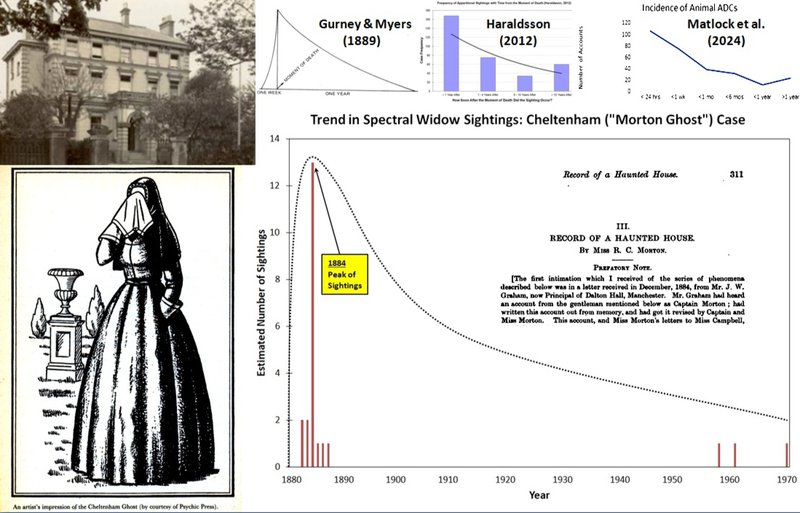
This made it possible to roughly approximate the yearly chronology for 23 sightings of the spectral widow (which is likely to be only a relatively small fraction of all the sightings that ever occurred). When plotted on a graph, the chronology looks something like what is shown in Figure 1.
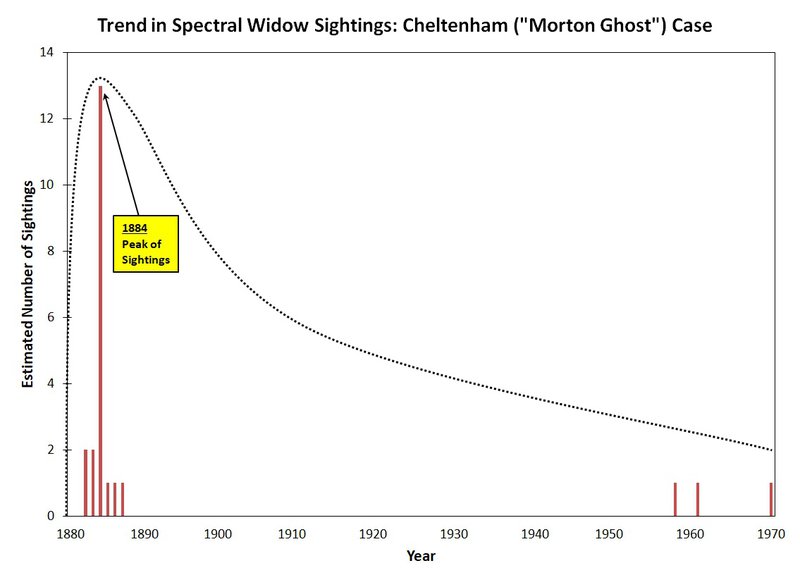
While remaining mindful of the caveat that there’s only a relatively small amount of data involved, the estimated trend (dotted line in Figure 1) would seem to suggest that a cluster of spectral widow sightings took place throughout most of the 1880s, with a peak period in sightings during the summer (particularly August) of 1884. After that period, the sightings began to decline over time, which would be consistent with Rosina’s own observation that: “The figure became much less substantial on its later appearances,” and was seen less and less as time went on [1, p. 321].
A Similar Pattern Among Ghost Sightings?
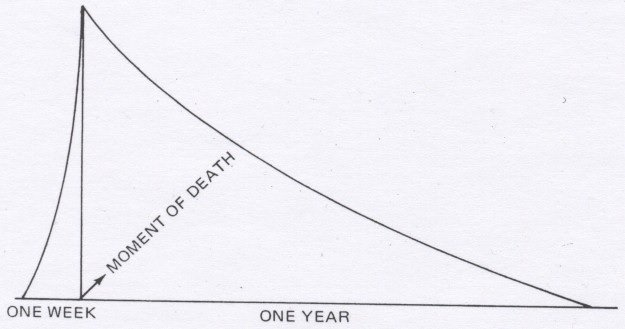
If the estimated trend seen in Figure 1 happens to be anywhere close to reflecting the actual pattern of ghost sightings, then it bears a notable degree of similarity to another kind of pattern seen in survey studies of reported apparition cases. This other kind of pattern was also first noticed in the 19th century by early psychical researchers Edmund Gurney and Frederic Myers [4] when they were looking at the number of spontaneous spectral sightings being reported before, at the moment of, and after the time of death. As can be seen in the graph reproduced in Figure 2, they found that the spectral sightings initially “…increase very rapidly for the few hours which precede death,” and then “…decrease rapidly in the few days after death, then more slowly; and after about a year’s time, they become so sporadic that we can no longer include them in a steadily decreasing line” [4, pp. 426 – 427].
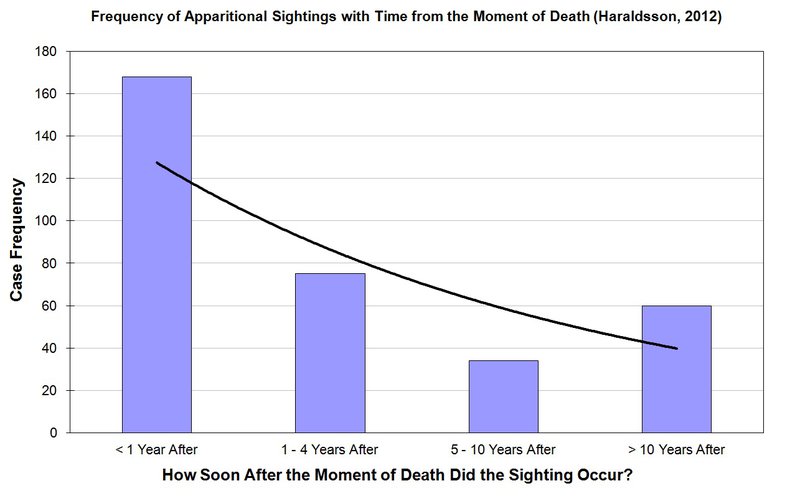
A somewhat similar kind of pattern seems to hold for more modern reports of ghost sightings, as well: Back in 2012, Icelandic researcher Erlendur Haraldsson reported a survey of 449 cases that he’d collected of spontaneous sightings of apparitions of the dead [5]. When I’d graphically plotted his case reports over the long term (Figure 3), they seemed to indicate that the number of reported sightings gets progressively smaller as the years pass from the time of death (with a slight upswing in reports occurring more than ten years after) [6].
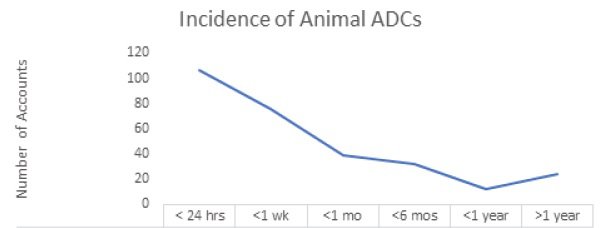
And as observed by researchers James Matlock, Beth Hilton, and their colleagues, this kind of pattern even holds for reported sightings made of animal apparitions (Figure 4).
A Possible Practical Take-Away Tip
When considered altogether, these findings seem to suggest that the number of reported spectral sightings tends to get less frequent as more time continues to pass. And if this happens to extend more widely to a number of haunting cases, then it may further suggest that while hauntings tend to last a long time, they don’t go on forever.
That would seem to further reinforce a practical consideration suggested earlier to ghost hunters and paranormal enthusiasts [6]: Be mindful of a location’s history of haunting, in order to see whether a visit might be worthwhile or not. Try to check up on the latest witness reports beforehand in order to determine how long ago phenomena were last reported there, and what was experienced. Has anyone seen the ghost there lately? If the location is a publicly accessible one, then there might be some time-stamped reviews and vlogs available on the Internet from other visitors who have been there, which can give hints about what has occurred (if anything) and how recently.
In doing this, it’s also good to be mindful that some publicly accessible locations may hype their reputed haunt as a tourist attraction. This means there’s a possibility that even though the haunting may have stopped, these locations could be aiming to keep the legend of haunting going, for the purpose of keeping up interest and drawing in more visitors – after all, who wants to visit a place that may no longer be haunted? When faced with such a potential situation, it may be good to further look into the quality of the witness reports coming from the location lately: Are the witnesses describing phenomena that come anywhere close to matching the kinds of phenomena that were experienced there in the more distant past? Or do the phenomena being reported lately seem relatively mundane? Weighing thoughts of this may be useful in deciding whether to make visit to the location or not.
For more details on this and other practical take-away tips that may be useful to consider on future ghost hunts, check out this article in the pages of PDN’s new Parawize Journal.
References
[1] Morton, R. C. [Despard, R. C.] (1892). Record of a haunted house. Proceedings of the Society for Psychical Research, 8, 311 – 332.
[2] Collins, B. A. (1948). The Cheltenham Ghost. Psychic Press Ltd.
[3] MacKenzie, A. (1988). Continuation of the “Record of a Haunted House.” Journal of the Society for Psychical Research, 55, 25 – 32.
[4] Gurney, E., & Myers, F. W. H. (1889). On apparitions occurring soon after death. Proceedings of the Society for Psychical Research, 5, 403 – 485.
[5] Haraldsson, E. (2012). The Departed Among the Living: An Investigative Study of Afterlife Encounters. White Crow Books.
[6] Williams, B. J. (2026). Seeking spectral insight: Some possible practical lessons for ghost hunting from parapsychological research. Parawize Journal, 1, 1 – 23. https://dx.doi.org/10.66589/rnc13b29
[7] Matlock, J. G., Hilton, B., Sheldrake, R., Smart, P., & Nahm, M. (2024). After-death communications (ADCs) from non-human animals: Parallels with human ADCs. Journal of Scientific Exploration, 38, 61 – 78. https://dx.doi.org/10.31275/20243087