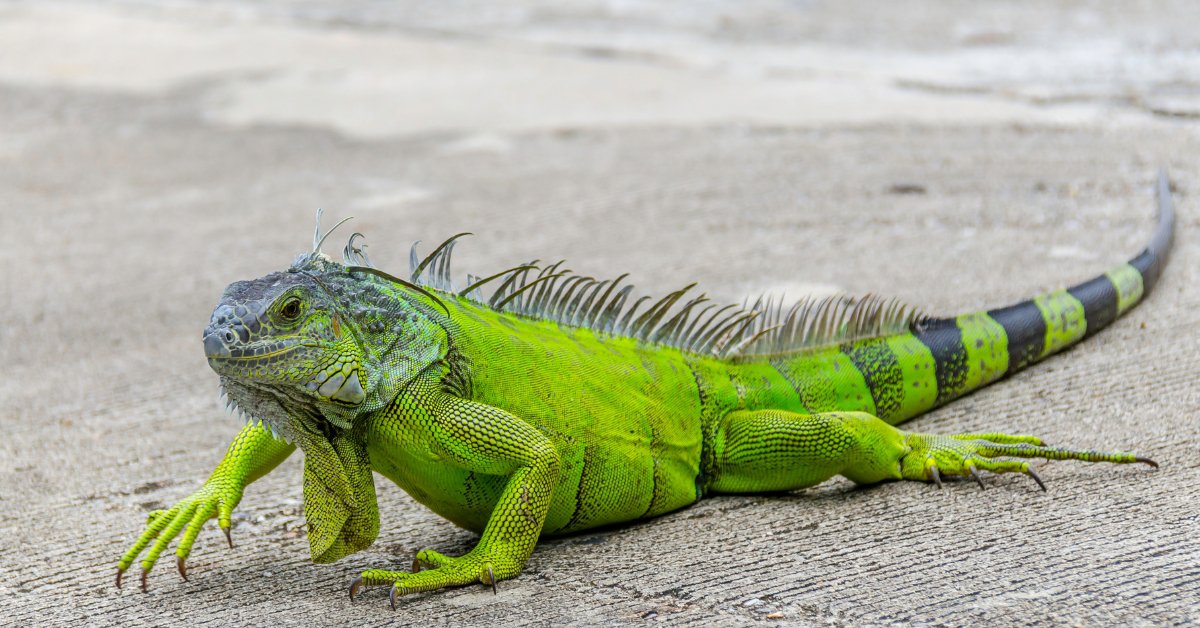
Invasive Iguanas Wreak Havoc On Florida’s Ecosystem
Florida — The clock may be ticking for several infamous invasive species that have firmly entrenched themselves in Florida's environment over time.
The well-known culprits primarily responsible for this havoc are voracious predators like the Burmese python and the Argentine black-and-white tegu lizard. However, there's another reptilian perpetrator with a herbivorous diet that's causing comparable destruction. Originating from Central and South America, as well as certain regions of the Caribbean, the green Invasive iguanas have been progressively extending their presence across Southern Florida. This expansion is attributed to their escape or deliberate release by pet owners.
As zoologist Ron Magill explained: “If they escape here in South Florida, it's like Club Med – they're out there enjoying this wonderful environment, no pressures on them.”

These exotic reptiles have persistently threatened Florida's natural balance, economy, and the well-being of its inhabitants. It is crucial for authorities to stress the importance of responsibly and compassionately removing creatures like the green iguana. This is necessary to address the growing issue of these animals infiltrating sewer systems and unexpectedly appearing in residents' toilets. Florida invests roughly $8 million annually to address the challenges posed by these invasive species. Florida invests roughly $8 million annually to address the challenges posed by these invasive species. These concerns have prompted authorities to advocate humanely removing creatures such as the green iguana, which has been notorious for infiltrating sewer systems and unexpectedly appearing in the toilets of unsuspecting residents. Florida invests roughly $8 million annually to address the challenges posed by these invasive species.
Invasive Iguanas Are Destroying Ecosystems
Devoid of natural adversaries, invasive iguanas flourish prominently in the South Florida region. With the potential to reach lengths of up to 6 feet (1.8 meters), their appetites are equally substantial and propagate at a concerning pace. These invasive creatures have increased the need to have them controlled by professional pest control operators and wildlife trappers.
They voraciously consume indigenous vegetation and cultivated crops, displacing smaller native lizards. Furthermore, they deplete the resources of flowering plants that play a crucial role in sustaining butterfly populations. The green iguanas are held accountable for eradicating the final documented habitats of the critically endangered Miami blue butterfly, a species exclusive to South Florida.
Tearing Up The Canals
Their destructive path isn't limited to Florida's wildlife alone; it extends to causing substantial harm to the region's infrastructure, potentially leading to flooding in certain areas. The combination of these assaults on infrastructure, coupled with the reptiles' ecological ramifications, could result in damages totaling billions of dollars, as noted by Kirkland.
One can observe hundreds of iguanas basking on boats or darting along the sea walls in the vicinity of the canals that feed into Florida's Biscayne Bay.
We asked a local Iguana control expert how prevalent they are in the area. Michael Ronquillo of Humane Iguana Control explained;
“Iguanas love the water, the foliage and of course, the climate. You will see them in the trees and in the pools of residential homes. They are fast and difficult to control for any homeowner. They also get easy access to the canals and can do a lot of damage to homes and businesses. These guys can swim really well and use the canals as easy gateways into the environment”

Banning Import, Breeding, Possession
In March of 2021, the Florida Fish and Wildlife Conservation Commission unanimously passed a prohibition on the import, breeding, and possessing of 16 of the most ecologically harmful nonnative species. This list comprises notorious invaders such as green invasive iguanas, the Argentine black and white tegus, and the Burmese python.
Among the listed species are the Nile monitor lizards, scrub pythons, and green anacondas. Under the newly enacted regulation, current tegus and green iguana owners are permitted to retain their animals, provided they obtain a no-cost permit and adhere to the recently implemented guidelines. However, upon the demise of their animals, they will not be allowed to acquire replacements. Commercial breeding of animals featured on the list is allowed to persist until June 2024, beyond which it has become proscribed.
Following extensive hours of online public hearings, during which reptile breeders, sellers, and pet owners expressed their dissent, the commission arrived at their decision through a formal vote.
Killing Them Humanely

Back in 2019, according to a news release from the Florida Fish and Wildlife Conservation Commission, individuals were advised to eliminate the presence of large green lizards from their properties and 22 designated public land areas throughout South Florida. However, the release does not provide specific details regarding how civilians should manage these lizards.
Like other non-native species, iguanas initially introduced to Florida either as pets or through inadvertent transport on vessels have found a favorable environment to thrive in the state. Iguanas were brought to Florida either as pets or by accident on boats. They like Florida's environment and are able to live well there.
While iguanas are permitted as pets in Florida, they are not protected by any law except those relating to cruelty towards animals, as outlined by the commission. These reptiles have inhabited South Florida since the 1960s, but their population has experienced a significant surge in recent years.
Although some sightings have been reported in the northern parts of Florida, their expansion there is somewhat restricted due to their intolerance for colder temperatures, as noted by the commission. When faced with cold spells, even in South Florida, iguanas often fall from trees and may appear lifeless, yet if left undisturbed, they will eventually regain their vitality.
The Wildlife Commission urges individuals who can no longer provide care for their iguanas to participate in the Exotic Pet Amnesty Program. This initiative facilitates the surrender of these pets to the agency, which matches the animals with prospective adoptive caregivers. Pest Control has become a necessary service in South Florida to control iguanas and reduce their path of destruction.

Related Posts

TOP 10 SURVIVALISTS IN THE WORLD

Attempted Assassination Of President Trump