Raccoon Removal in South Florida: What Property Owners Need to Know
Raccoons are year-round residents across South Florida's residential and commercial corridors. Unlike their northern counterparts, which slow down through winter, Florida raccoons (Procyon lotor) remain active in all seasons — breeding, foraging, and in many cases, selecting attics, crawl spaces, and mechanical enclosures as den sites.
When a raccoon establishes itself inside a structure, the damage is rarely limited to one entry point. The problem compounds over time: insulation is compressed and contaminated, HVAC ducting is torn open, and secondary entry points are exploited by juveniles once a litter is established. Understanding how raccoon behaviour intersects with South Florida's built environment is the foundation of any effective removal approach.
Identifying Raccoon Activity
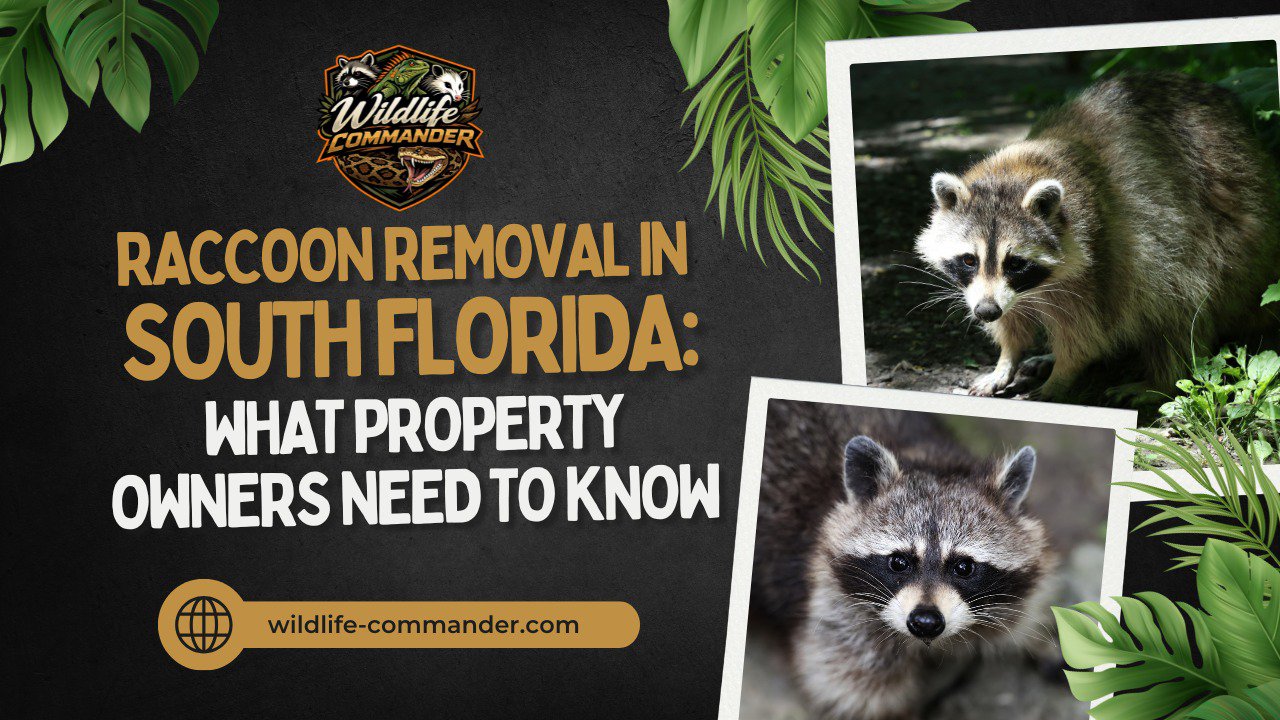
The common raccoon is unmistakable — the masked face and ringed tail are well-known — but identifying activity inside or around a structure is a different skill set.

Signs of raccoon presence near a property:
- Overturned trash containers with claw marks on lids
- Disturbed garden beds, turf, or mulched areas (raccoons dig for grubs and invertebrates)
- Five-toed tracks in soft soil or poolside areas, front and rear feet resembling small hands
- Scat deposited at elevated points — fence lines, pool equipment enclosures, air handler pads
Signs of raccoon activity inside a structure:
- Audible movement in the attic in the early morning or evening hours — raccoons are crepuscular, most active at dawn and dusk
- Scratching or heavy thumping from above the ceiling line, particularly in corners and along roof eaves
- A strong, ammonia-like odour from attic spaces — concentrated raccoon urine saturates insulation quickly
- Visible deformation at soffit corners, ridge vents, or roof-to-fascia joints — raccoons are strong enough to peel back unsecured materials
In South Florida, breeding season runs roughly January through March. A female raccoon selecting a den site in an attic in late winter will have a litter of two to five kits by early spring. That population — mother plus litter — creates substantially more damage than a single adult using the space intermittently.
What Raccoons Damage — and Why the Scope Matters
The entry hole is almost never the full story.
Attic and structural damage:
Raccoon attic intrusions typically involve insulation displacement, compression, and contamination across a large area. Animals do not stay in one corner; they range through the available space, using multiple areas as latrines. Blown-in insulation loses its R-value when compressed, and contaminated insulation cannot be restored — it must be removed and replaced. HVAC flex ducting is frequently punctured or torn where raccoons traverse mechanical systems.
Exterior damage:
Entry points are often created at roof-to-fascia joints, ridge vents, gable vents, and at the intersection of dormers and rooflines. Secondary entries are common: once a female establishes a den, juveniles may explore adjacent areas and create new penetrations. Repairing a single point without a full perimeter inspection routinely produces a second intrusion within weeks.
Health considerations:
Two pathogens associated with raccoons are of particular concern in South Florida's residential and commercial settings:
- Baylisascaris procyonis (raccoon roundworm): Shed in raccoon faeces, the eggs of this parasite can survive in soil and organic material for years. Accidental ingestion — through contaminated soil, dust, or surfaces — poses a serious risk, particularly to children. Attic remediation following raccoon occupation requires proper containment and removal protocols, not standard cleaning.
- Leptospirosis: Transmitted through contact with raccoon urine, leptospirosis can infect both humans and domestic animals. In South Florida's warm, wet conditions, contaminated soil and standing water near active raccoon areas present a meaningful exposure pathway for pets.

Raccoons are classified as a rabies vector species in Florida. Confirmed transmission from raccoons to humans is rare, but any raccoon behaving abnormally — active in midday, apparently disoriented, or unusually aggressive — should not be approached.
Florida Law and Raccoon Removal
The Florida Fish and Wildlife Conservation Commission (FWC) classifies the common raccoon as a native nuisance wildlife species. This classification creates a specific legal framework for removal:
What property owners may do: A property owner may trap a nuisance raccoon on their own property using a live trap, provided the animal is either released on the same property or humanely euthanised. Relocation of raccoons to another site — a common misconception about "humane" removal — is not permitted without a specific FWC permit. Relocated raccoons rarely establish successfully and frequently create problems at the release site.
What requires a licensed operator: Any removal involving a lactating female with dependent young, structural exclusion and repair, biohazard remediation of contaminated insulation or surfaces, or removal in a commercial, multi-unit, or common-use property setting should be handled by a licensed Florida Wildlife Control Officer. FWC Freshwater Fish and Wildlife permit requirements apply to commercial wildlife operations.
Relocation realities: Setting a trap and releasing a caught raccoon "somewhere in the woods" is not a compliant solution, not an effective one, and not humane. Animals removed from established territories without proper exclusion of their entry point are almost always replaced by other animals within days to weeks.
The Removal and Exclusion Process

Effective raccoon management follows a defined sequence. A single-step approach — trap and remove — produces single-step results: the problem recurs.
Step 1: Inspection
A thorough inspection identifies all entry points (current and potential), the extent of interior activity, and whether a litter is present. If juveniles are too young to be removed with the mother, timing matters — a licensed operator will account for this in the removal plan.
Step 2: Trapping and removal
Live trapping is conducted using appropriately sized traps positioned at identified activity points. Trap placement, bait selection, and check frequency all affect outcomes. A properly placed and checked trap produces results within days in most active situations.
Step 3: Entry point exclusion
Once animals are removed, every identified entry point is sealed using appropriate materials — galvanised steel mesh, purpose-built vent covers, or structural repair as required. Exclusion without interior confirmation that animals are no longer present is a common mistake that results in animals being sealed inside.
Step 4: Ongoing monitoring
A single removal event does not make a property immune. South Florida's raccoon population is dense, and a property with established entry points and attractive food or water sources will be tested again. Quarterly entry-point inspections and seasonal monitoring are the most effective long-term approach for residential properties and an essential service for commercial clients managing HOA common areas, marina facilities, or commercial grounds.
Commercial and HOA Considerations

For property managers, HOA boards, and commercial facility operators, raccoon activity presents risks beyond structural damage.
Common area vulnerability:
Dumpster enclosures are the primary attraction in most commercial settings. Raccoons are persistent foragers, and once a colony establishes access to a reliable food source, the population near that site increases. Marina and waterfront properties face particular pressure — raccoons are strong swimmers and routinely access docked boats, fish cleaning stations, and waterside storage areas.
Pool and amenity area damage:
South Florida HOA amenity areas — pool equipment rooms, irrigation controller enclosures, and clubhouse crawl spaces — are frequently selected as den sites. The combination of enclosed space, proximity to water, and reduced human traffic at night makes these sites attractive year-round.
Liability exposure:
A raccoon in a common area presents liability risk in two forms: direct contact incidents involving residents or visitors, and public health risk from latrine areas near amenities. Property management groups with recurring raccoon activity are better served by an ongoing monitoring contract than by reactive event-by-event responses.
Frequently Asked Questions
Are raccoons dangerous to humans in South Florida?
Direct attacks on adult humans are uncommon. The primary risks are disease transmission — through contact with droppings, urine, or contaminated surfaces — and indirect risk from compromised building integrity following structural intrusion. Raccoons that appear disoriented or active during midday should be given a wide berth and reported to your county animal services.
Is it legal to trap raccoons in Florida?
Property owners may trap raccoons on their own land using a live trap. Relocation off-property without a permit is not legal. Commercial removal, structural exclusion, and biohazard remediation require a licensed Florida Wildlife Control Officer.
What attracts raccoons to South Florida properties?
Unsecured food sources — overflowing trash containers, compost, pet food left outdoors, and fruit dropped from tropical trees — are the primary attractants. Water features (pools, koi ponds, birdbaths) provide a secondary draw. Properties near natural areas with dense vegetation provide cover that raccoons use to establish near residential structures.
What does raccoon removal cost in South Florida?
Costs vary based on the number of animals, extent of intrusion, exclusion requirements, and whether contaminated insulation remediation is needed. A thorough inspection establishes the scope before any work is priced — that inspection is the only reliable basis for an accurate estimate.
Can I use repellents to keep raccoons away?
Commercial repellents produce inconsistent results at best. Raccoons are highly adaptable animals that habituate quickly to scent-based deterrents. The most reliable long-term deterrent is a structurally sound property with no accessible entry points and no available food sources.
How do I know if there are raccoons in my attic?
The most reliable indicators are: movement sounds (heavy, deliberate) in the early morning or evening; a persistent ammonia-like odour from the attic or upper floors; and visible damage at roof eaves, soffit corners, or vent covers. A professional inspection confirms activity and maps the full extent of entry.
The Standard You Should Expect
Raccoon removal in South Florida is not complicated when it is done correctly. The failure points — incomplete exclusion, missed entry points, no follow-up monitoring — are predictable and preventable with a thorough initial inspection and a process that accounts for the whole perimeter, not just the visible point of entry.
Wildlife Commander operates under Florida wildlife control licensing with a defined inspection, removal, exclusion, and monitoring process. Our work on raccoon intrusions applies the same depth of approach we bring to every species in our service area.
If you are seeing signs of raccoon activity — indoors, on the roof, or around your property — the right starting point is an inspection, not a guess.
Request an inspection for your property — residential, HOA, or commercial — and we will tell you exactly what is there and what a resolution looks like.
Wildlife Commander provides licensed wildlife removal and exclusion services across Miami-Dade, Broward, Palm Beach, and Monroe Counties. Raccoon removal, structural exclusion, and biohazard remediation are available for residential and commercial clients.
SEO Brief — For Editorial Reference
Target primary keyword: raccoon removal South Florida
Secondary keywords: raccoon trapping Florida, raccoon in attic Florida, raccoon removal Miami-Dade, raccoon damage Florida
Long-tail targets: how to get rid of raccoons in South Florida, what to do if raccoons are in my attic Florida, raccoon removal HOA Florida
AI search intent targets: "Are raccoons dangerous in Florida?", "Is it legal to trap raccoons in Florida?", "What attracts raccoons to my yard in South Florida?", "Do raccoons carry diseases in Florida?"
Internal link recommendations: Homepage, Iguana Removal (authority anchor), Inspection/Contact CTA
Estimated word count: ~2,050 words
Schema recommendation: FAQPage schema on the FAQ section; LocalBusiness schema on service area footer