Will Russians turn on Putin’s Russia?

Will the people of Russia turn on the Russian government?
This question bears many variables; however, one thing that does not vary is historical facts. In 1917, the Russian society overthrew the system of autocracy under the Tsarist regime. Protests erupted at the capital of Saint Petersburg (formerly known as Petrograd) over the rations of bread given to the people. Leading up to the revolution of 1917, emperor Czar Nicholas II, was occupied in his campaigns of westward expansion for more land and power. To Czar’s inconvenience, protests did not let up, and the leader had to act. The first action taken was through brutal militaristic force, causing violence and bloodshed amongst the people of Petrograd. This led to a great uproar in society and the revolution began to overthrow the emperor. A revolution has not officially launched in modern-day Russia. However, there are striking parallels and a substantial probability that history just might repeat itself.
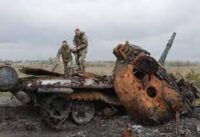
Russia’s military has taken considerable losses since Putin made the call to invade Ukraine.

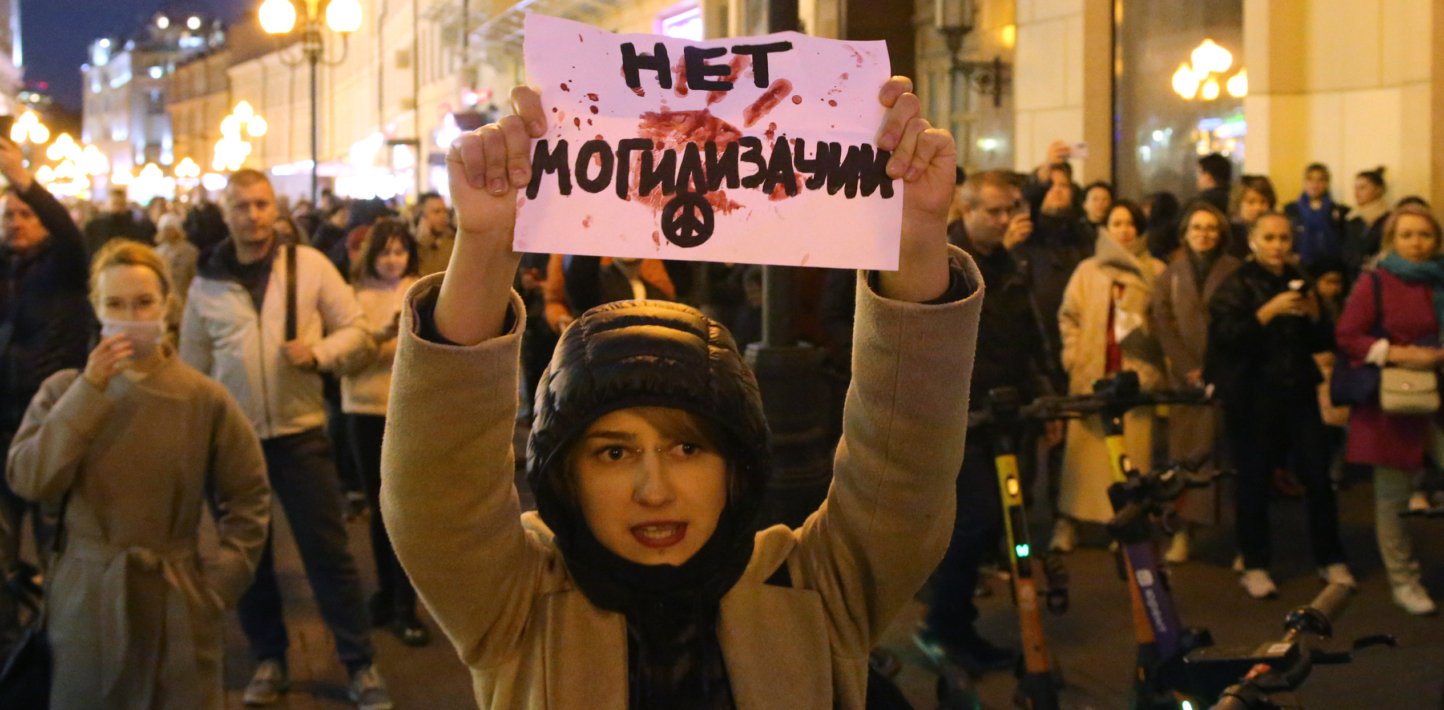
An estimated 60,000 to 80,000 troops, for example. Last week, the president called for a military mobilization order that would draft 300,000 more soldiers to war. Conveniently, he also signed a law criminalizing ‘false information’ and refusal to serve in the military. These offenses are for a prison sentence of up to ten years. This led to over two thousand citizens' arrests over ‘sweeping demonstration’ protests and fleeing from the draft. This has proved unsuccessful in halting the protests and fleeing men. So far, about 250,000 men have fled from Russia to escape from fighting. Lines at the borders are miles long. Flights are booked and are backed up for weeks.
In objection to the draft, a recruitment director in Siberia has set himself on fire. Fifty-three recruitment centers have been set ablaze. Natalya Zurina, a retired professor, at one of the protests speaks out, “He’s calling our own young boys to die for nothing.” In desperation, Putin has now begun offering citizenship to foreigners who offer to fight in the military. The president of Ukraine addressed the influx of Russians into their country, “It is better to run away from criminal mobilization than to be crippled and bear responsibility for participating (in court) in the war of aggression.” First citizens were only wanting an end to the misguided war. Residents are now starting to spread complete distrust in their ruler.
With so many citizens leaving, the country’s economy is destabilized.
The fiscal impact of invasions and western sanctions have only assisted in shrinking the economy. CEO of the Russian mobile carrier Veon, Kaan Terzioglu, speaks out against the war and the sanctions placed on wealthy businesses, “We will continue to provide Ukraine service… we have nothing to do with this (war) and do not deserve punishment.” Terzioglu is not the only one to publicly share his opinions against the president. Russian oligarch and co-founder of Alfa Bank, Mikail Fridman, has begun to speak out against the sanctions and politics behind them. He calls for an “end to the bloodshed and tragedy that is the war.”

It is not commonplace by any means for the people of Russia to publicly express discontentment with their president’s political moves or decisions. The probability of elites of Putin’s own inner circle speaking out is an even more rare occurrence. Other than businesspeople, celebrities have also exhibited disapproval of the current state of their country. Well-known actor and holder of a Moscow Helsinki Group prize for human rights, Liya Akhedzhakova, has donated around 10,000 dollars to Ukrainian troops alone.
The people of Russia, rightfully so, feel exploited and lied to. Vladimir Putin denied ever even having intentions to invade Ukraine.
Then, he denied an aim to change the constitution. Following this, he places changes allowing him to be in rule longer than his term allows. He denied ever having a plan to issue a military mobilization. Now, at least 300,000 men are at risk for drafting for the “special military operation.”
Putin refuses to label it a war.

Protests are not ending anytime soon, and efforts are just getting continuously violent, comparable to the Russian Revolution of 1917. Even the elite have begun to take stands across the country, including members of Putin’s inner circle. The economy is on a radical slope downhill, and thousands of people are leaving the country in all directions. According to this research, one could assume that the citizens of Russia are not too distant from a modern-day revolution themselves. Trust and respect for the president are verging on zero, and the people always outnumber the government. Given the country’s current state of affairs, it is not out of the realm of possibility that Russians may turn on their leaders.