Putin’s Russia Compared to Nazi Germany
While Putin has claimed that Russian soldiers are “fighting for the same thing their fathers and grandfathers did”, UK defense secretary Ben Wallace says Putin’s Russia mirrors Nazi fascism. Putin expressed this during his speech at Russia’s Victory Day parade which took place on Monday 9 May.
“Their unprovoked and illegal invasion of Ukraine, attacks against innocent women and children – corrupt’s the memory of past sacrifices and Russia’s once-proud global reputation,” said Wallace in a speech at the National Army Museum in London.
Russia organizes an annual Victory Parade to celebrate the win over Nazi Germany at the end of WW2. Soldiers and tanks of the Russian Armed Forces, many who are now fighting in Ukraine, parade through Moscow and other Russian cities. Under Putin’s regime, Victory Day has been used to show off military prowess, including the strength of troops and military hardware. Obviously, the parade is now over, but it is reminiscent of the parades in Hitler's Nazi Germany.
Moscow’s Supposed Fight ‘Against Nazism’ Is This Putin’s Russia Now and The Reason For War In Ukraine?
Putin partly justified his invasion of Ukraine by claiming that Ukraine needs to be ‘de-Nazified’, and that its leaders, including Ukraine’s Jewish president Volodymyr Zelenskyy, are themselves Nazis. Although there are right-wing extremists within Ukraine, these fractions are small and not influential. Political experts pointed out that what Putin had in mind was eliminating not fascism, but any distinct Ukrainian identity, with talk of Ukrainians needing to be ‘re-educated’.

At the Victory March, Putin told Russians that the West was “preparing for the invasion of our land, including Crimea”, which is the peninsula annexed by Russia in 2014. He suggested that Ukraine was being armed for this purpose. “Today, I want to address our armed forces and Donbas fighters, you are fighting for the victory of your land,” he continued, “You are fighting for [..] its future.”
Professor Michael Clarke, associate director of Exeter University's Strategic Studies Institute, told Euronews that Putin has been revising Russian history for decades.
While previously Putin would mark Victory Day by praising both Russia and its allies for their common WW2 victory, today his tone is marked with more Russian nationalism. Although Russia did bear the brunt of casualties during WW2, his re-writing of history is unbalanced. “The way Putin speaks now, you would think Russia was the only country that fought,” he said.
‘Rashism’: Putin’s Fascist Regime
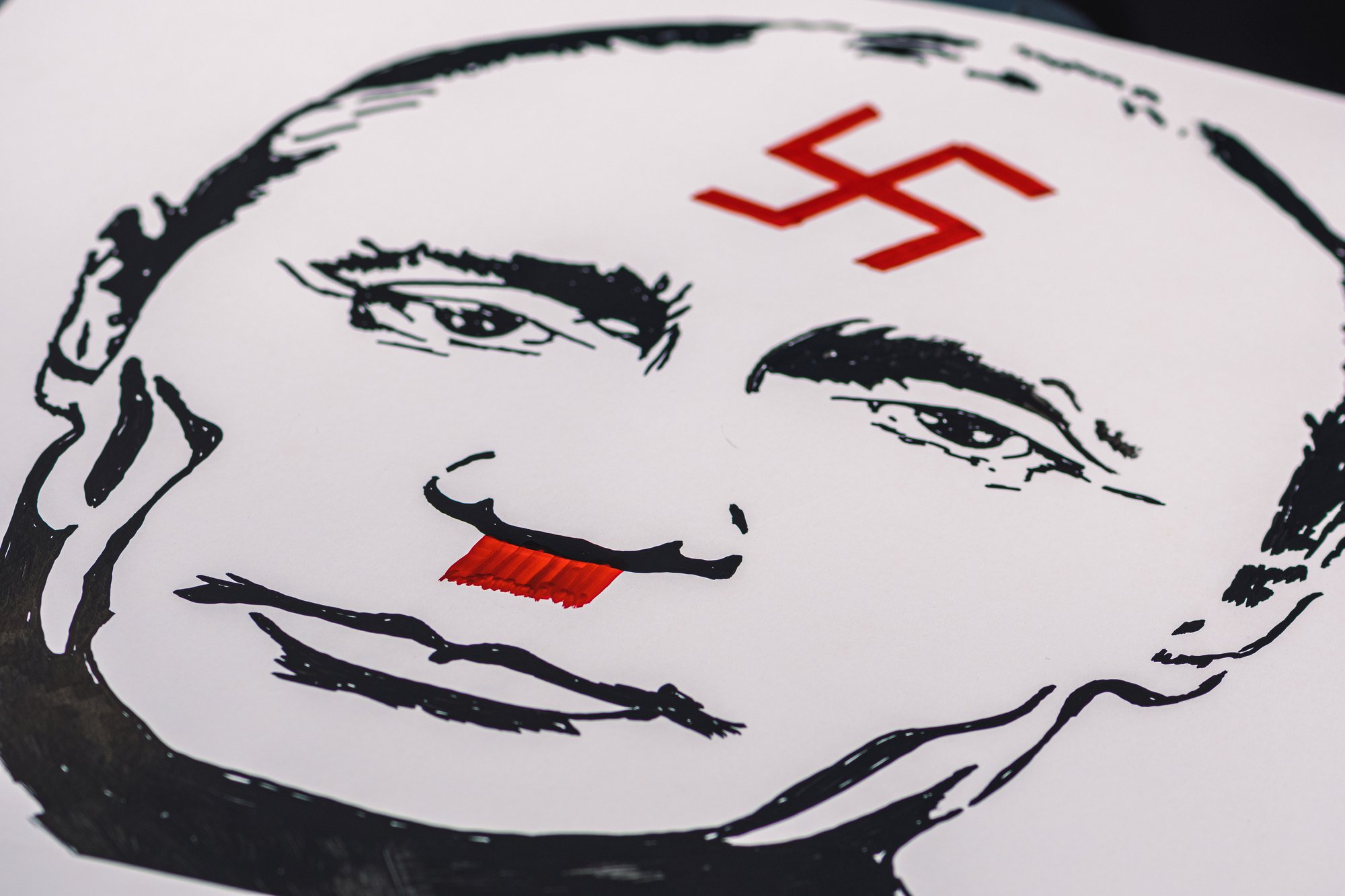
Putin’s remarks seem paradoxical given the mounting evidence that shows Putin’s Russia to be closely following fascist tendencies itself. Since the invasion of Ukraine began, Ukrainian media, public, and policymakers have started calling Putin-led Russia as “rashist”: a play on the words ‘Russia’ and ‘fascist’.
Most commentators and political scientists have been reluctant to attribute the ‘f-word’ to Russia, preferring to dub it as merely authoritarian. But its recent invasion of Ukraine has re-ignited conversations around using the term.
An authoritarian state is generally defined as one that circumvents civil liberties such as press or religion freedom, is undemocratic, and relies on the state bureaucracy, military, and secret police to ingrain its power.
Fascist states share the same features as authoritarian states, but with one key difference: the aura of their leader. Whereas the leaders of authoritarian states generally stay out of the limelight, political scientist of Rutgers University, Alexander Motyl, defines fascism as: “..an authoritarian state ruled by a charismatic leader enjoying a personality cult.” This means that the leader both exudes charisma and enjoys popular support among their people.
Russian Acceptance
Although there is some dissent, especially among the youth, Russian citizens generally accept Russia’s nationalist narrative. Motyl says that “a hyper-nationalist, imperialist and supremacist ideology that glorifies all things Russian and legitimates expansion as Russia’s right and duty has been both imposed on and willingly accepted by the population.”
This popular support has also become evident during the current invasion. Many Russians were either shocked at, or were dubious of, the evidence showing Russia’s aggressive destruction in Ukraine. Instead, many believe the stories of the tightly controlled Russian media, according to which, military operations are happening in Ukraine, but that it is in the best interests of the Ukrainian people and civilians are not being targeted. But the rising number of civilian causalities – currently totalling 3,381people – tells a different tale.
Motyl notes that the Russian state also shares other fascist features, such as continually using coercion and violence, promoting chauvinist and racist ideologies, and having ambitions of national expansion.
Some political scientists, such as Marlene Laruelle of George Washington University, argue that claims of fascism against Russia are politically motivated. “[It is a way for] geopolitical rivals [..] to frame their own vision of the world and claim the moral high ground,” she explains, “it is ultimately an attempt to determine the role of Russia in Europe's future.”
Perhaps only time will tell whether political scientists reach a consensus on calling Russia ‘fascist’. But it is clear that, as Wallace suggested, Russia shares at least some features with fascist Nazi Germany, the defeat of whom Putin has vehemently celebrated.